Beyond Dialogue: Building Hindu–Jewish Friendship Through Understanding, Trust, and Shared Experiences
Reflections on Yom Kippur, antisemitism, cultural identity, and the relationships that bring our communities together
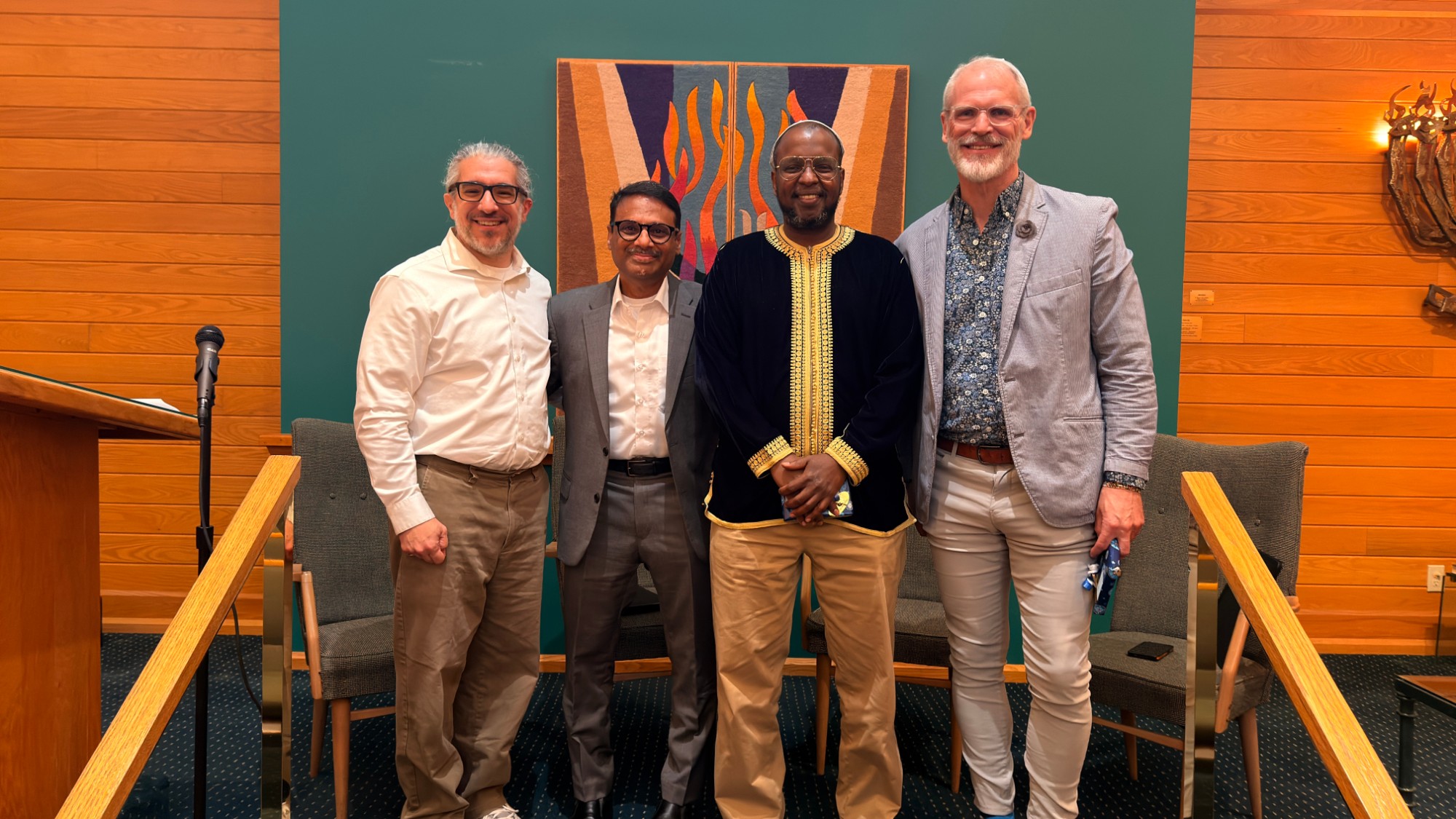
Yesterday, I had the privilege of joining our Jewish brothers and sisters at Congregation Beth-El Zedeck in Indianapolis for Yom Kippur, the holiest day in the Jewish calendar.
Rabbi Hal Schevitz invited me to participate in an interfaith panel alongside Christian and Muslim faith leaders. There was an interesting coincidence: all three of us have served as Board Chair of the Center for Interfaith Cooperation (CIC). My fellow panelists are former chairs, while I currently serve in that role.
Our conversation lasted an hour and fifteen minutes. We discussed antisemitism, the challenges facing our respective communities, religious and cultural identities, and the longstanding relationship between Hindus and Jews.
I learned a great deal, but the gathering also reinforced something I have come to believe through years of interfaith engagement:
We cannot build meaningful relationships simply by knowing about one another. We must take the time to know one another.
Yom Kippur: A Day of Reflection and Renewal
Before reflecting on our discussion, I want to share something I learned about Yom Kippur itself.
Yom Kippur, the Day of Atonement, is devoted to repentance, forgiveness, introspection, and spiritual renewal.
In traditional Jewish observance, the day includes five forms of abstention: refraining from eating and drinking, bathing, applying oils or lotions, wearing leather footwear, and engaging in marital intimacy. There are important exceptions, particularly when health and safety are involved.
As a Hindu, I found the emphasis on self-discipline and introspection deeply relatable. Our religious traditions have different theological foundations and practices, yet both recognize the importance of examining our actions and renewing our commitment to living with greater awareness.
It was in this spirit of reflection that our conversation began.
Does Your Community Recognize Antisemitism?
One of the questions posed to the panel was particularly important:
“Does your community know about antisemitism? Are they aware of what the Jewish community is experiencing?”
I shared that members of the Hindu community are aware of antisemitic incidents and the challenges confronting our Jewish neighbors.
However, I also emphasized that awareness alone is not enough.
Reading about an antisemitic incident in the news is one thing. Understanding the historical, cultural, and religious context behind that incident is another.
I was struck by how uneven the awareness of antisemitism seemed to be across the communities represented in the room. Some of the responses reminded me that even communities that live alongside one another may not fully understand each other’s historical wounds, fears, and lived experiences. I do not see this as a criticism of any particular community, but rather as evidence of how much work all of us still have to do.
One of my fellow panelists put it succinctly:
“Text without context becomes a pretext.”
That observation stayed with me. When words, religious teachings, historical events, or even contemporary conflicts are separated from their broader context, they can easily be used to reinforce assumptions we already hold about one another.
This is why religious literacy matters. Understanding another faith requires more than quoting its texts or knowing a few facts. It requires understanding its history, lived experience, internal diversity, and how members of that community understand their own tradition.
If we do not understand Jewish history, identity, and the experiences of Jewish Americans, how can we consistently recognize antisemitism when it appears in unfamiliar forms?
How can we identify harmful stereotypes? How do we distinguish honest disagreement from prejudice directed toward an entire community?
This is where I believe grassroots interfaith engagement becomes essential.
We need opportunities for ordinary members of our communities—not just religious leaders—to interact, ask questions, and understand one another.
I shared an example from our own work in Indiana.
Ancient Traditions, Modern Conversations: Learning in Each Other’s Homes
Through our Ancient Traditions, Modern Conversations series, we created opportunities for Hindu and Jewish community members to learn directly from one another.
In one session, a Jewish presenter visited a Hindu home.
Our guest shared the history of the Jewish people, their cultural traditions, religious practices, and experiences. They even brought traditional Jewish food for us to taste!
It was not merely a lecture.
We were gathered in someone’s home, sharing stories, asking questions, and learning through conversation and food.
The Hindu community reciprocated by organizing a session at the Jewish Community Center (JCC).
We shared the civilizational history of Hindu Dharma, our customs, traditions, festivals, and different understandings of divinity. We explored the diversity within Hindu religious thought and how our traditions continue to shape our lives in America.
These exchanges helped us understand one another beyond the limited descriptions we encounter in textbooks or news headlines.
A Jewish family is no longer simply a distant community we read about. They become friends whose traditions we have experienced.
Likewise, Hindu traditions become more familiar to our Jewish neighbors because they have heard about them directly from practicing Hindus.
That familiarity matters.
When someone encounters an antisemitic or anti-Hindu claim, personal knowledge and relationships can help them recognize misinformation and resist stereotypes.
Religious literacy is not merely an academic exercise. It is a practical foundation for mutual respect and solidarity.
That is why I believe our communities should invest more time in grassroots cultural exchanges, especially involving families and younger generations.
Different Histories, Familiar Patterns of Prejudice
Another question concerned the challenges facing our respective religious communities.
I spoke about the hostility that Indian Americans and Hindu Americans sometimes encounter in public conversations, particularly around immigration and employment.
The H-1B visa program, for example, has become a subject of intense debate in the United States. It raises legitimate questions about employment, wages, immigration policy, and the needs of American businesses. Recent policy changes have also brought renewed attention to the program.
These questions deserve serious discussion.
However, I am concerned when a debate about immigration policy turns into hostility toward Indian Americans as a group.
Expressions such as “taking our jobs” can become sweeping accusations against an entire community when they are used without regard for individual circumstances.
Indian Americans are not a monolithic group. They have different professional backgrounds, immigration histories, political views, and personal experiences.
Yet individuals can find themselves judged not for their actions but for their ethnicity or country of origin.
Our Jewish friends know this experience well. Jewish Americans are sometimes held collectively responsible for events and decisions far from their own lives, simply because they are Jewish. Hindu Americans, too, can find themselves expected to answer for events overseas because of their faith or ancestry.
In both cases, the individual disappears behind an assumption about the group.
The histories and manifestations of antisemitism and anti-Hindu prejudice are different. I would not suggest that every incident has the same motivation or that the same groups are necessarily responsible.
Nevertheless, I see similarities in how stereotypes, collective blame, and oversimplified narratives can be used against communities.
Recognizing these patterns is one area where our communities can learn from one another.
Labels and the People Behind Them
An attendee asked what it means to be a Zionist. The question reminded me of a similar conversation that often takes place in my own community around the word Hindutva.
Zionism is the movement for Jewish self-determination in the Jewish people’s historical homeland. For many Jews, it reflects a connection to that land that runs through centuries of prayer, scripture, and tradition. It has also taken many forms, and what it means today is debated both within Jewish communities and beyond them.
Hindutva literally means “Hinduness,” the essence of being Hindu. For many who identify with the term, it represents Hindu civilizational identity, cultural continuity, and the preservation of traditions and heritage. In contemporary discourse, it is also associated with Hindu nationalism, and its meaning is actively debated.
These differing interpretations are a reminder to listen to how a community defines its own identity, while still leaving room for informed discussion.
What I shared was narrower. Labels like these are sometimes used as shortcuts.
A Jewish person is called a Zionist, and others assume they already know that person’s politics. A Hindu American speaks with pride about Hindu heritage, and others make the same kind of assumption.
In both cases, the label replaces the conversation. We stop asking what the person actually believes.
Being Jewish or Hindu does not tell us what someone thinks about politics, here or abroad. And feeling a cultural or spiritual connection to an ancestral homeland is not the same as holding a particular political position.
Ideas should remain open to discussion. But the discussion goes better when we begin by asking people what they think rather than assuming we already know.
This is another reason our grassroots programs matter. When we have taken the time to understand one another’s history and culture, we are better equipped to have difficult conversations without reducing one another to labels.
Learning From the Jewish Community’s Experience
During our conversation, I also reflected on how Hindu Americans can learn from the Jewish community’s experience in responding to prejudice.
Jewish organizations have spent generations developing institutions focused on education, community security, civil rights, documenting antisemitic incidents, and public engagement.
Organizations such as the Anti-Defamation League provide educational resources and systems for documenting and understanding antisemitism.
The Hindu American community has been developing its own organizations, forums, and approaches to addressing discrimination and misconceptions.
I believe we need to continue strengthening our coordination and our ability to respond when Hindu Americans face genuine prejudice.
That includes documenting incidents accurately, educating the broader public about Hindu traditions, engaging civic institutions, and developing relationships with other communities.
But organization alone is not sufficient.
Our response must also be grounded in credibility.
Not every disagreement is an attack, and not every criticism is evidence of prejudice. We must be able to distinguish legitimate disagreement from misinformation, stereotyping, and discrimination.
If we want others to recognize prejudice against our communities, we must demonstrate that we are equally willing to examine the evidence carefully and respect honest differences of opinion.
This is one more reason Hindu–Jewish dialogue can be meaningful.
We can exchange experiences, understand the challenges each community faces, and learn how to respond constructively without assuming that our histories or perspectives are identical.
When Our Communities Stood Together in Grief
As the conversation continued, I was reminded of two experiences that profoundly shaped my understanding of Hindu–Jewish friendship in Indiana.
On October 9, 2023, just two days after the Hamas terrorist attacks in Israel, a few of us from the Hindu community quietly attended a prayer vigil organized by the Jewish community in Indianapolis.
We came to stand with our Jewish friends.
We listened. We prayed. We shared their grief.
After the gathering, several Jewish friends approached us to express their gratitude. Some had tears in their eyes.
I remember being deeply moved, although I did not fully understand why our presence had meant so much.
A year and a half later, that experience came full circle.
On May 3, 2025, the Hindu community gathered in Carmel to honor the victims of the terrorist attack in Pahalgam, Kashmir.
Jewish organizations and community leaders came to stand with us. Members of their congregations attended the vigil, offered prayers, and shared our sorrow.
They were there for us.
It was a profoundly moving moment.
I had written about these two experiences in my earlier reflection, Two Civilizations, One Wound: Hindu-Jewish Solidarity in the Face of Terror.
That evening in Carmel, I finally understood the gratitude we had witnessed in October 2023.
When a community is grieving, the simple presence of a friend can mean more than any carefully prepared speech.
Nobody was keeping score.
We were there for each other because our relationships had grown beyond formal interfaith engagement.
Friendship becomes real when we show up, especially when there is nothing to gain except the comfort of being present.
An Ancient Friendship With a Living History
Another question during the panel concerned the relationship between Hindu and Jewish communities.
What makes this relationship distinctive?
I spoke about the long history of Jewish communities in India, including the Bene Israel, and the centuries of cultural coexistence that form part of our shared history.
Jewish communities have lived in different parts of India for generations, maintaining their religious traditions while participating in the broader cultural life of the country.
Their experiences offer important examples of how distinct religious identities can coexist and interact over time.
I also shared the story of Maharaja Digvijaysinhji of Nawanagar, who welcomed approximately 1,000 Polish refugee children during World War II when they desperately needed shelter.
Their story illustrates the importance of compassion toward people facing displacement and persecution.
For me, such histories are not simply stories about the past.
They raise an important question about the present:
What are we doing today to ensure that the next generation inherits these relationships?
Historical goodwill cannot sustain itself.
It needs to be renewed through regular interactions, shared experiences, and a willingness to stand together during difficult moments.
The friendship between Hindu and Jewish communities in Indiana has been strengthened through precisely these kinds of efforts.
Our cultural exchanges, visits to places of worship, interfaith conversations, and shared vigils have helped transform historical connections into personal relationships.
From Interfaith Dialogue to Interfaith Friendship
Through my years of involvement with the Center for Interfaith Cooperation and the Indiana Multifaith Network, I have come to recognize an important distinction between interfaith dialogue and interfaith friendship.
Dialogue is often organized around an event.
We invite religious leaders, assemble a panel, discuss a topic, take a group photograph, and return home.
These conversations are valuable, but what happens afterward?
Do we continue talking?
Do our families get to know one another?
Do we visit one another’s places of worship?
Do we invite each other into our homes?
Do we know enough about our neighbors to recognize when they are being unfairly targeted?
And will we stand beside them when they need us?
Our Ancient Traditions, Modern Conversations series offers one answer.
Our experiences at the Jewish vigil in Indianapolis and the Hindu vigil in Carmel offer another.
In one setting, we learned about one another through history, culture, and food.
In another, we learned about one another through grief, empathy, and presence.
Both experiences helped deepen our relationships.
Interfaith work should create opportunities for both.
Understanding helps us recognize one another. Friendship gives us a reason to remain present in one another’s lives.
The Conversation Continues
I am grateful to Rabbi Hal Schevitz for inviting us to participate in this sacred occasion and for creating an environment where meaningful and sometimes difficult questions could be discussed openly.
I also appreciated the perspectives shared by my fellow Christian and Muslim panelists.
The panel has ended, but the questions it raised deserve continued attention.
How can our communities improve religious literacy?
How do we recognize and respond to prejudice?
How do we keep disagreements from turning into hostility toward religious and ethnic communities?
And how do we ensure that our relationships are strong enough to endure disagreement?
These are not questions that can be resolved in a single panel discussion.
But they are exactly the kinds of questions we should continue asking one another.
As I left Congregation Beth-El Zedeck, I was reminded that our Hindu–Jewish friendship in Indiana did not develop overnight.
It grew through conversations in living rooms, cultural exchanges, visits to one another’s institutions, shared meals, and moments when we stood together in grief.
The greatest strength of these relationships is not that we agree on everything.
It is that we have learned to care about one another even when our experiences, beliefs, or perspectives differ.
We often talk about building bridges between communities. But bridges are not built through declarations. They are built through repeated acts of trust, understanding, and presence.
Our conversation continues.
And so does our friendship.
Shalom. Namaste. 🙏
For Reflection
When did you last move from knowing about a neighbor of another faith to truly knowing them?
Get notified of new essays
No spam. Unsubscribe any time.