Three Worlds, One Journey: Peru and the Art of Keeping Moving
On altitude, ancient stone, and what human beings are capable of when they build something in the belief that it matters
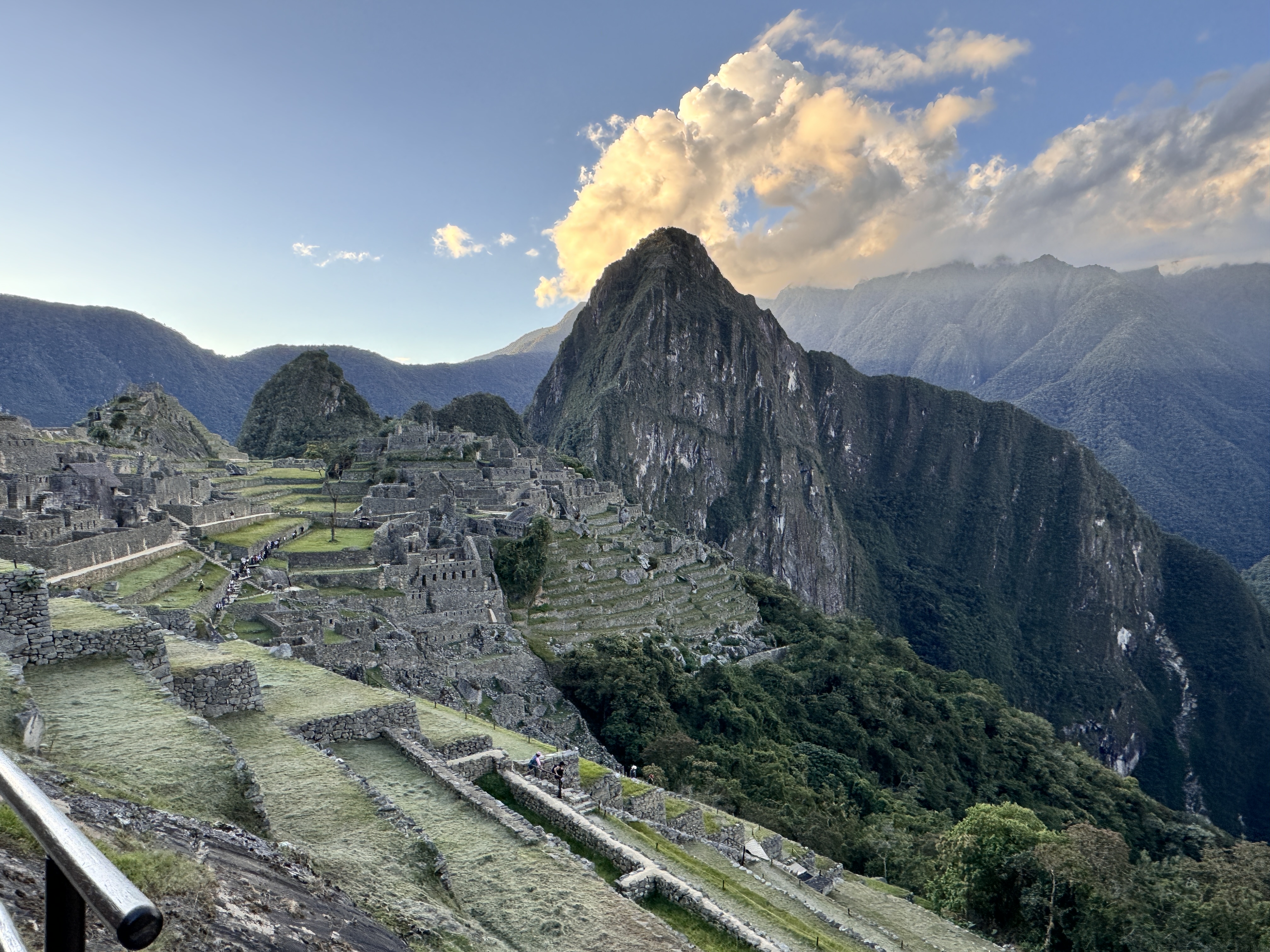
Peru announces itself in thirds. La Costa, the Pacific coastline. La Selva, the Amazon basin. La Sierra, the spine of the Andes. Over fourteen days in May, our family — joined by my brother's family flying in from Detroit — moved through all three, and what we discovered was not simply a country but a civilization compressed into landscape: 5,000 years of human ingenuity, faith, and endurance written into stone, soil, and altitude.
We flew into Lima in the small hours of a Friday morning, the city still dark when we arrived. Our tour began at 9 a.m. — arranged with care by Valencia Travel Cusco, whose patience in finalizing our itinerary was, itself, a kind of grace.
Lima: La Costa
Lima is a city that does not announce its depths. But spend a day inside it and the layers begin to reveal themselves. We moved through the bohemian streets of Barranco, descended into the catacombs beneath the San Francisco Monastery, and stood before the pre-Columbian collections of the Larco Museum, where civilizations whose names we barely knew — Norte Chico, Chavín, Nazca, Moche — looked back at us from ceramic faces thousands of years old.
Our guide Erica spoke about her native culture with a quiet pride that stayed with me. Before the Incas, she reminded us, Peru was already ancient. These were peoples who lived in harmony with the natural world not as a philosophy but as a practice — a way of being that modern civilization has largely forgotten and is only now, haltingly, trying to remember.
We ended that first day with pisco sours and ceviche — the national dish, served cold, sharp with lime, the trout impossibly fresh. A fitting introduction to a cuisine that would continue to astonish us across every region.
Puerto Maldonado: La Selva
A flight delay the following morning cost us a day, but the Amazon does not keep schedules. We arrived by boat at EcoAmazonia Lodge in the Tambopata National Reserve — 2.6 million acres of the Madre de Dios, one of the most biodiverse places on earth — after an hour moving through the river's brown water into the green wall of the jungle.
The rainforest operates on a different frequency. You stop thinking in terms of itineraries and begin simply paying attention: to the macaws cutting color across the canopy, to the giant otters moving through the water with uncanny ease, to the caimans motionless on the bank and the capybaras grazing without concern at the edge of the trees. The Tambopata holds 1,200 butterfly species. Six hundred bird species. Two hundred mammals. Walking through it, you understand that the word biodiversity is simply a scientific attempt to describe something miraculous.
In the Amazon kitchen, our meals arrived wrapped in leaves — curcuma-infused rice with vegetables, cooked the traditional way, tasting faintly of earth and smoke. Nature's own packaging and flavor, inseparable.
Cusco and the Sacred Valley: La Sierra
We flew into Cusco at 11,500 feet, and the altitude made itself known immediately. The first day was quiet by necessity — coca tea, muña tea, and the slow patience of acclimatization. The body must negotiate with the Andes before the Andes will let you move through them.
Cusco itself is a city built on erasure and continuity at once. At Koricancha, the great Inca temple of the sun, the Spanish conquistadors stripped the gold from the walls but could not pull down the foundations — their own Church of Santo Domingo now sits atop Inca stonework so precisely fitted that no mortar was ever needed. The Cathedral of Cusco, built upon an ancient shrine, is filled with the paintings of the Cuzco School, where indigenous artisans quietly wove jaguar faces and Andean symbols into the margins of Catholic iconography. Resistance, it turns out, has many vocabularies.
The Sacred Valley opened before us over a full day's exploration — Pisac, Ollantaytambo, Maras, Moray, Chinchero, the Urubamba River threading through them all. Civilizations have farmed this valley since at least 800 BC. We fed llamas at the roadside and watched a bird named Jatayu — enormous-winged, improbably graceful — ride thermals above the ancient terraces. Time, in the Sacred Valley, moves differently.
The Inca Trail and Machu Picchu
The short Inca Trail begins with a train and ends with your own legs. We trekked 11.5 kilometers over seven hours — uneven stone paths, steep climbs, the air thin and honest — stopping first at Wiñay Wayna, "Forever Young," an Inca site perched at 2,680 meters above the Urubamba gorge, its terraced hillside a testament to what human beings will build when they believe something is worth building.
Inti Punku, the Sun Gate, came next. This is where the Inca sun god was honored at the summer solstice, and this is where Machu Picchu first reveals itself to the approaching pilgrim. There is no adequate way to describe the moment. The city simply appears — impossibly complete, impossibly beautiful — and every mile of the trail becomes, retroactively, exactly the right preparation.
The next morning we spent two hours inside Machu Picchu with our guide Andres — the House of the Guardian, the Intihuatana stone, the Temple of the Sun, the Sacred Plaza, the agricultural terraces cascading down toward cloud-wrapped peaks. The Incas built this city in the 15th century, at altitude, with no iron tools and no wheeled vehicles. Standing in it, you do not merely admire their engineering. You feel the scale of what human devotion can accomplish.
Rainbow Mountain
Our final Peruvian adventure belonged to Vinicunca — Rainbow Mountain. We were picked up before dawn and driven four hours to the trailhead. Of our original group of eight, four made the climb. The Andes are not for the faint of heart, and altitude is the great equalizer.
The entire Vinicunca trail sits above 15,000 feet. The summit reaches 17,068 — the same elevation as Everest Base Camp. The trail is only 2.5 miles, but every step at that altitude costs something. What waited at the top was worth every labored breath: stripes of daffodil yellow, coppery green, deep scarlet, and burnt orange layered across the mountain's flanks — mineral deposits laid down over millennia, now exposed by retreating glaciers.
"Nature as abstract painting. Geology as wonder."
The Flavors of Peru
A journey through Peru is also a journey through one of the world's great food cultures, shaped by three distinct geographies and thousands of years of cultivation. Ceviche — cold, bright, lime-sharp — was the constant. Quinoa soup at Indio Feliz in Machu Picchu was one of the finest soups any of us had ever eaten. Trout appeared in every form: grilled, sautéed, Chinese-style at Yaku in Cusco, always exceptional. We tried alpaca burger (closer to rabbit than beef, and better than you'd expect). In the Amazon, we ate from leaves. In Lima's Miraflores on our last day, we discovered Asianica street food — a vegan paradise that stopped us cold with its beauty and its flavor.
Peru has 3,000 varieties of potato. The pisco sour — pisco, lime, egg white, bitters — is less a drink than a cultural institution. We tried it in every region. It improved each time.
Charaiveti
There is a kind of travel that confirms what you already know. And then there is the kind that undoes your assumptions about what civilization means, what time means, what human beings are capable of when they build something — a temple, a city, a trail through the mountains — in the belief that it matters.
Peru is the second kind. It asks something of you. The altitude asks it of your lungs. The trail asks it of your legs. The Inca stonework asks it of your imagination. Rainbow Mountain asks it of everything you have left.
We gave what we had. We carried it forward — one step, one breath, one vibrant world at a time.
Our deepest gratitude to Diego and the entire Valencia Travel Cusco team, whose meticulous arrangements made it possible for us to simply be present for all of it.
For Reflection
What is something you've built, or are building, in the belief that it matters — even if you'll never see it finished?
Get notified of new essays
No spam. Unsubscribe any time.