A Yatra in Three Movements: Roots, Return, and First Darshan
Thirty days, fifteen cities, nineteen mandirs — and the slow recognition that some journeys carry you back to who you already were
There are journeys we take for the first time. And there are journeys we take again — not because we have forgotten, but because we have not yet finished understanding. The thirty days that carried me through fifteen cities, nineteen mandirs, four forts, and the Great Indian Desert were both at once: a return to what the blood remembers and an opening toward what the eyes had never seen.
This yatra was not measured in miles. It was measured in time — time folding gently back upon itself, time standing still at the threshold of a sanctum, time revealing itself as something that neither passes nor accumulates but simply deepens.
First Movement: Vattem — Where Faith Became Family Legacy
Every pilgrim carries within them a place that is not merely sacred but constitutive — a place without which the self cannot fully be explained. For me, that place is Vattem.
The Vattem Venkateshwara Swamy Devasthanam and the Vattem Chennakeshwara Temple are not temples I visit. They are who we are. This is our ancestral village, and the Venkateshwara Swamy temple is a true labor of love — built patiently, brick by brick, prayer by prayer — by my Nana and Amma as founder trustees. To walk its stone pathways is to feel the quiet dignity of seva embodied in every threshold, every corridor, every lamp that has been lit in devotion across decades.
I have returned to Venkateshwara Swamy six times now, to Chennakeshwara twice. These are not repetitions. They are renewals. Each darshan carries within it a gratitude I cannot always articulate — for a generation that chose to anchor us in shraddha and service rather than merely inheritance and comfort. To stand before the deity here is to understand that devotion, when it is transmitted faithfully, does not diminish across generations. It accumulates.
Second Movement: Srisailam — A 35-Year Reunion With Childhood
Srisailam was woven into the fabric of my childhood summers — our family's annual pilgrimages, the Inole home of my Ammamma just steps from the temple complex, the forest roads, the temple queues, the particular innocence of those years when faith is absorbed rather than chosen. I had not returned in thirty-five years.
The temple has changed in its surfaces — modern amenities now layer themselves over the ancient form — but the aura has not changed. The Jyotirlinga of Mallikarjuna Swamy remains exactly as I held it in memory: immense, still, radiating a silence that the centuries have only deepened. Standing before it again, I felt the intervening decades compress — not disappear, but fold inward, as if time were acknowledging the reunion.
I participated in Chandi Homam during this visit, and it was there that the circle felt complete. This was not merely darshan. It was reconciliation — with time, with distance, with the boy who had stood in this same place and could not yet have known what the years ahead would carry.
Third Movement: Tamil Nadu — Eight Days of First Darshan
At Ramanathaswamy in Rameswaram, I completed the 22 Theertha Snanam — those purifying ritual baths in the temple's sacred waters — and emerged feeling scrubbed clean of something I had not known I was carrying. Walking the famed corridors with their 1,008 pillars was like moving through living architecture: the stone itself seemed to breathe.
At Meenakshi Amman in Madurai, devotion unfolded in color and sound. To see Meenakshi Amman adorned in white saree was, simply, bliss — the gentleness of the goddess in her most luminous form. Ranganathaswamy at Srirangam introduced me to a different quality of stillness; the darshan of Ramanujacharya — whose body has been preserved for nearly a thousand years — added a profound dimension: the sense that certain truths are considered too important to let time erase them entirely.
At Brihadeeswarar in Thanjavur, the Vimana Gopuram — crowned with eighty single-stone blocks quarried and lifted by hands that had no machine beyond ingenuity and faith — rises in a silence that is somehow louder than anything around it. This is what civilization looks like when it is oriented toward the eternal.
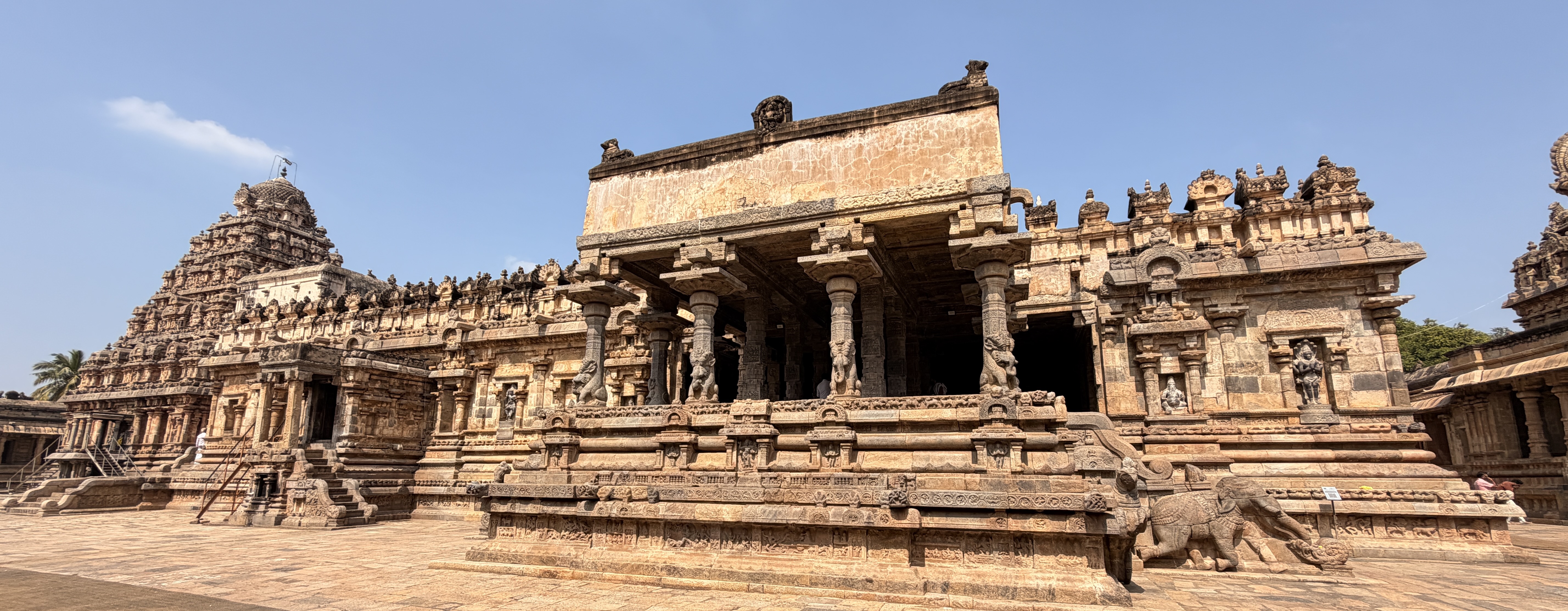
At the Nataraja Temple in Chidambaram, Shiva revealed Himself not as form but as akasha — space itself. The Chidambara Rahasyam, the sacred secret at the heart of the sanctum, is not a thing to be explained. It is a thing to be stood before. Kumbakonam offered theology in balance. Vaitheeswaran Koil whispered of healing. The Airavatesvara Temple in Darasuram brought this Tamil chapter to a close with refined, meditative elegance — a 12th-century Chola masterpiece that asks very little of you except your complete attention.
Fourth Movement: Rajasthan — Five Days of Desert and Silence
Jodhpur received me with its blue-city calm — indigo homes stacked against the hillside, and the watchful presence of Mehrangarh Fort above everything. There is something grounding in Jodhpur I did not expect: an unhurried quality, a sense that the city has decided not to perform its antiquity but simply to live it.
The Thar Desert brought a different kind of meditation. Vast horizons. Quiet sunsets. The sky so wide that the self becomes, appropriately, small. Spirituality does not always announce itself through architecture and ritual. Sometimes it arrives as an absence — of noise, of agenda, of the accumulated weight of everything we carry indoors.
In Jaisalmer, the golden fort was extraordinary for a reason I had not anticipated: it is still lived in. History here has not been cordoned off behind glass. It breathes, it cooks, it sleeps, it opens its doors in the morning. Within the fort, a Jain mandir stopped me completely — delicate marble carvings, an interior geometry of symmetry and restraint, devotion expressed through discipline rather than grandeur. Against the harsh expanse of the Thar outside, this cool, precise sanctum was its own kind of answer.
Fifth Movement: Kerala — Eight Days of Return and Rest
The final leg arrived gently, as Kerala always does. I came primarily for an Ayurveda reset, and as the body recalibrated in that slow, deliberate way that Ayurveda demands, the spirit followed in its own time.
At Sree Padmanabhaswamy Temple in Thiruvananthapuram, the discipline of the protocol and the depth of the devotion felt perfectly matched. At Vivekananda Rock Memorial in Kanyakumari — that singular point where three seas meet and the subcontinent ends — I stood where Swami Vivekananda had sat in meditation for three days before finding his clarity. Standing there, I could understand why he chose this particular place to ask his deepest questions.
At Suchindram, the Thanumalayan Temple offered something philosophically complete: Shiva, Vishnu, and Brahma unified within a single sanctum — not as theological compromise but as theological truth. At Azhimala Shiva Temple, with the Arabian Sea crashing on the rocks below, I stood before Shiva in his most elemental form — timeless, unmoved, indifferent to centuries in the way that only the eternal can be. The waves were loud. The sanctum was still.
What the Elders Always Knew
Our elders called these journeys theertha yatras — pilgrimages to sacred waters — and they undertook them not as tourism or achievement, but as grounding practice. They understood something that modern life works very hard to obscure: that we are more than our routines and our roles, and that we require, periodically, to be reminded of this.
This yatra carried three distinct layers: the rootedness of Vattem, the return of Srisailam, and the first encounters across Tamil Nadu, Rajasthan, and Kerala. The true measure was none of the distances or the numbers. It was coming home to oneself — to a faith inherited rather than merely adopted, a continuity felt rather than merely studied, a gratitude that needed, in the end, no words at all.
"Charaiveti. Keep moving. But know, always, where you began."
For Reflection
Is there a place your family's faith or history is rooted that you haven't yet returned to?
Get notified of new essays
No spam. Unsubscribe any time.