Football, Food, and Faith: A Journey Through Spain
A 15-day sojourn from Barcelona to Madrid — and the Moorish thread that runs through it all
Life is an extraordinary journey, and one of its greatest joys lies in experiencing diverse cultures, traditions, and customs. When we open ourselves to the world, we embark on a quest to enrich our lives.
15 day sojourn through Spain — beginning in Barcelona and winding through Montserrat, the White Villages, Ronda, Seville, Granada, Toledo, Segovia, and finally Madrid — wove together three threads that seemed to define the country everywhere we turned: football, food, and faith. And running beneath all of it, like an underground river, was the long, layered legacy of the Moors.
Barcelona: Gaudí, the Gothic Quarter, and Camp Nou
Our journey began in Barcelona, Catalonia's cosmopolitan gem. Four days barely scratched the surface. The Sagrada Família stopped us cold — Gaudí's unfinished masterpiece, its facades so intricate they seemed less carved than grown. Park Güell enchanted with its colorful mosaics and panoramic views. The Gothic Quarter drew us into its labyrinthine medieval streets, where history pressed in from every side and cozy cafés waited around every corner.
La Rambla pulsed with energy — street performers, bustling markets, the particular electricity of a city fully alive to itself. The Picasso Museum offered a quiet counterpoint, tracing the evolution of a singular artistic mind through paintings, sculptures, ceramics, and sketches. Casa Batlló and Casa Milà left us shaking our heads in admiration; Gaudí's genius refuses to be absorbed in a single visit.
In Spain, football is not a sport — it is a way of life. When we crossed the threshold into Camp Nou, FC Barcelona's iconic home, the air itself seemed to change. The stadium filled with a symphony of chants, the stands alive in vibrant color. The devotion on display that afternoon was less spectator passion and more something closer to prayer — a testament to the unbreakable bond between a club and its city.
We savored the culinary counterpart: paella, tapas, crema catalana. After a day on the rocky trails of Montserrat — where a solitary guitarist played haunting melodies in a hidden nook — we found ourselves in a cozy restaurant lingering over patatas bravas and richly seasoned chorizo, grateful for small perfections.
Seville: The Moorish Inheritance
Venturing south, the Moorish influence announced itself unmistakably. The dynasty that held the Iberian Peninsula from the 8th to the 15th century left more than architecture — it left language. Approximately 4,000 Spanish words carry Arabic roots: arroz (rice), azúcar (sugar), even rojo (red). The ordinary vocabulary of daily life quietly testifies to centuries of cultural exchange.
In Seville, the Royal Alcázar was our first deep encounter with this inheritance — an exquisite fusion of Moorish and Renaissance architecture, its gardens immaculate, its tilework mesmerizing, its UNESCO designation entirely deserved. The Seville Cathedral, one of the largest Gothic cathedrals in the world, rose above the city with quiet authority; we climbed the Giralda Tower and looked out over a skyline shaped by centuries of competing visions.
That evening, we witnessed flamenco in an intimate tablao — the dancers close enough to feel the percussion of their footfalls, the music soulful and insistent. It was the kind of performance that doesn't translate into description; it simply stays with you.
The tapas bars of Seville deserve their own chapter. Gambas al ajillo — garlic-infused prawns sizzling in olive oil — filled the air with an aroma that still comes back to me. The spirit of the place was camaraderie: small plates shared, conversations stretched long into the warm evening.
Granada: The Alhambra and the Weight of History
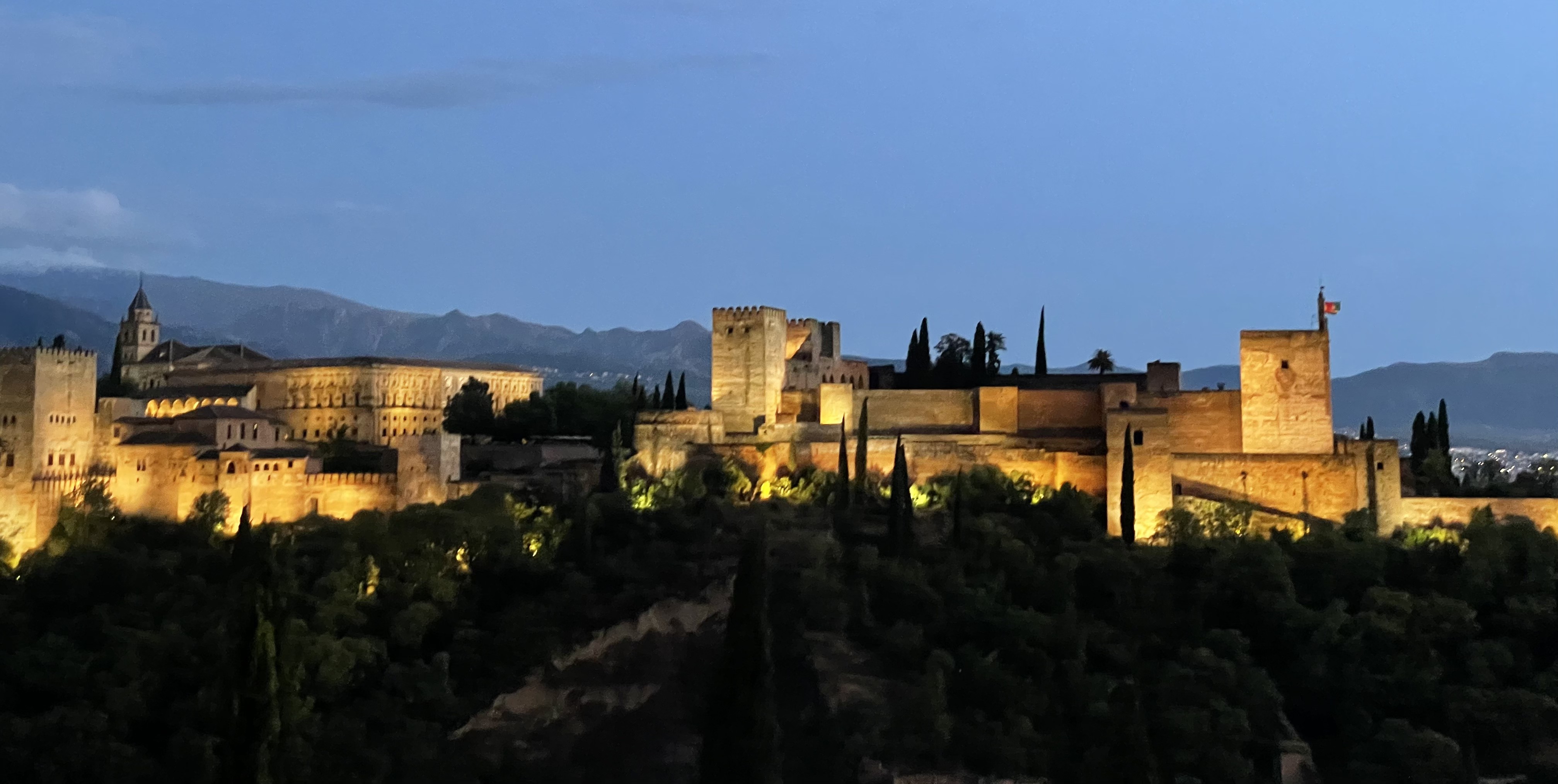
Granada held the Alhambra. To stand inside its geometric courtyards, to trace the arabesques with your eyes, to feel the silence that collects in its arched passageways — it is to understand, viscerally, what the word masterpiece actually means. No photograph prepares you.
The Spanish Inquisition casts a long shadow here. During that painful chapter, the Moors — who had introduced Islam to Spain — became targets of oppression. Mosques were converted into churches, their forms transformed but not entirely erased. What resulted, paradoxically, was a hybrid architecture of unexpected beauty: soaring ceilings, elaborate altars, ornate decoration built atop — and sometimes incorporating — the Islamic geometry beneath. The city's cuisine carries the same layered quality, bearing the imprint of both Moorish and Castilian traditions in every bite.
Toledo, Segovia, and Madrid
Our day trip from Madrid brought us first to Toledo, rightly called the "City of Three Cultures." For centuries, Christian, Muslim, and Jewish communities lived within its walls in a coexistence that, whatever its tensions, produced something remarkable. The Toledo Cathedral is an architectural masterpiece; the Alcázar, perched at the city's highest point, offers views that put the whole of human ambition in perspective.
Segovia offered wonders of a different kind — its Roman aqueduct, dating to the 1st century AD, still standing with impeccable dignity after two thousand years. The fairy-tale Alcázar of Segovia, turrets rising above the surrounding countryside, seemed to belong to a story not yet fully told. The Gothic cathedral completed the trinity, its spires dominating the skyline with quiet confidence.
Madrid, finally, was a fitting culmination. The Royal Palace — the largest in Europe, with 321 rooms — allowed us into 14 opulent chambers, each a study in grandeur. The Prado anchored an afternoon in the company of Velázquez, Goya, El Greco, and Bosch; to move through those galleries is to move through the whole arc of European art. In the streets outside, the aroma of fried calamari drifted from tapas bars, and we surrendered to it gladly.
Charaiveti
Our sojourn in Spain was a reminder that life's richest rewards lie in genuine encounter — with history, with architecture, with a stranger's cuisine, with a tradition not your own. Football, food, and faith: in Spain, these are not three separate domains but a single conversation the country has been having with itself for centuries, and generously extends to every visitor willing to listen.
"Spain, you have bestowed upon us a gift beyond measure. We carry it forward — one vibrant experience at a time."
For Reflection
What has an unfamiliar cuisine, language, or ritual taught you about your own traditions?
Get notified of new essays
No spam. Unsubscribe any time.